
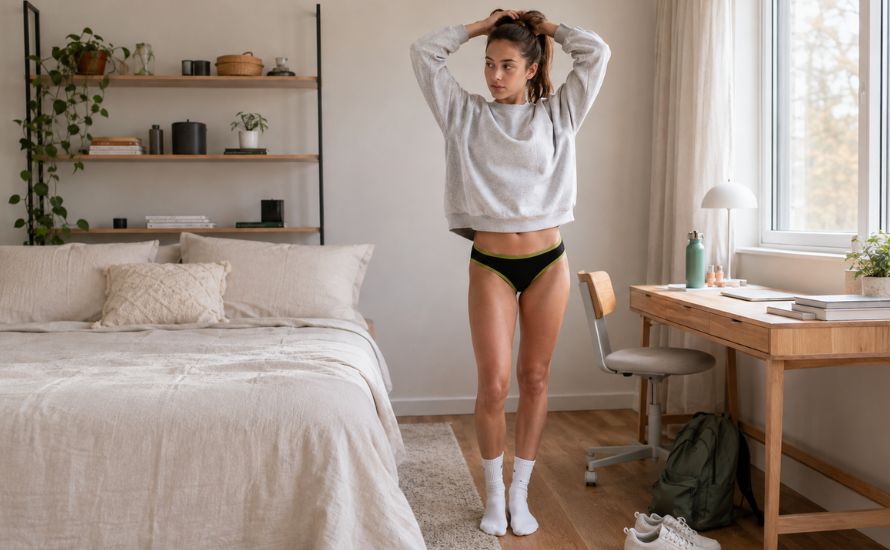
Choosing the first pair of period underwear can raise as many questions as the garment promises reassurance: what absorbency is needed, how should it fit, will it work for a full school day, and when should it be changed? The best choice does not depend on one feature alone, but on the combination of flow, size, length of wear and each teenager’s routine.
Period underwear for teens works as reusable absorbent underwear. Its purpose is to support the menstrual cycle with a garment that feels familiar, stays securely in place and allows normal movement. For the experience to be positive, the teenager should understand how to use it and take part in choosing the style, without presenting menstruation as a problem that needs to be hidden.
At ZD Zero Defects, the TEENS line includes Milda with medium absorbency and Mirta with high absorbency. Both feature a bikini cut, a black colour and green edging that distinguishes the younger line.
The best period underwear is not the one that promises to cover every situation, but the one that suits the flow, size and real moment of use.
1. What to consider before choosing period underwear for teens
Before choosing a style, it helps to answer five simple questions. These factors can prevent both insufficient protection and a garment that is more absorbent or bulky than necessary:
- Is the flow usually light, medium or heavy at that point in the cycle?
- Will the garment be worn for a few hours, a full school day or overnight?
- Will it be worn on its own or as backup alongside another menstrual product during the adjustment period?
- Which underwear cut does the teenager usually wear, and which feels most comfortable?
- Does the size keep the absorbent area in contact with the body without feeling restrictive?
During the first cycles, flow may be irregular and a clear routine may not yet have developed. It can therefore be sensible to begin with more than one absorbency level and observe which combination works best on different days.
2. Medium or high absorbency: how to decide
The absorbency level indicates the capacity of the technical area to manage menstrual flow, but it does not determine by itself how many hours the garment can be worn. Flow varies from one person to another and throughout the same cycle. A feeling of dampness, the weight of the garment and the wearing experience are more useful indicators than a general time estimate.
Medium absorbency
This may suit moderate-flow days, the beginning or end of a period, a few hours at home or a first trial to understand how the garment performs. Within the ZD line, Milda is the TEENS style with medium absorbency.
High absorbency
This may be more appropriate on heavier-flow days, during long days or when an additional margin of protection is preferred. Mirta is the TEENS style with high absorbency. Greater absorbency does not remove the need to check the garment and change it whenever necessary.
| Typical situation | Option to consider | What to observe |
|---|---|---|
| First or final days of the period | Medium absorbency | Actual flow, length of wear and any feeling of dampness. |
| Middle days with heavier flow | High absorbency | Whether the garment remains dry and stable throughout the routine. |
| First experience with period underwear | Medium or high, depending on flow | Start at home or during a controlled period to build confidence. |
| Long school day | According to flow; carry a spare | Actual duration, activity, access to a bathroom and the possibility of changing. |
| Overnight | Absorbency and cut suited to the flow | Coverage, sleeping position and comfort, without assuming that one style works for everyone. |
3. The correct size matters as much as absorbency
Period underwear should sit close to the body so that the absorbent area works in the intended position, but it should not dig in, leave deep marks or restrict movement. A size that is too large may shift and create gaps; a size that is too small concentrates pressure and puts unnecessary strain on seams and elastic.
- The waistband sits evenly and does not move down when walking or sitting.
- The absorbent area remains centred and in contact with the body.
- The leg openings do not gape or compress the groin.
- The teenager can bend, walk and sit without readjusting the garment.
- The cut is similar to the type of underwear in which the teenager already feels comfortable.
Before choosing, consult the ZD size guide and compare the measurements with the relevant chart instead of selecting a size by age alone.
4. A TEENS design should feel familiar and discreet
During adolescence, acceptance of the garment matters as much as its function. A design that feels too different from everyday underwear may cause reluctance, particularly around the first periods. A bikini cut allows period underwear to feel like an ordinary pair of briefs with integrated protection rather than an external menstrual product.
A dark colour can make visible staining easier to manage, while the green edging of the TEENS line gives it a distinct identity without making the garment feel childish. Discretion also depends on thickness, fit and how the garment sits under a school uniform, trousers or sportswear.
5. What to consider for school
A school day combines long periods of sitting, moving between classes, breaks and sometimes physical activity. For period underwear for teens to provide reassurance, it helps to prepare a simple routine before leaving home:
- Choose the absorbency level according to the day of the cycle, not only the expected length of wear.
- Carry a spare garment in a clean, discreet pouch.
- Prepare a separate waterproof bag or washable pouch for storing the used garment.
- Know how to recognise a feeling of dampness or saturation.
- Combine period underwear with another product during the adjustment period if the teenager prefers.
Confidence grows when there is a clear change plan and the teenager knows what to do, even if the spare garment is ultimately not needed.
6. Sport, sleep and first periods: each situation is different
During physical activity
The garment should remain stable and should not bunch up during movement. For a physical education class or light activity, check the fit beforehand and consider the flow level. During intense sport, the frequency of changing may differ because of movement and body moisture.
Overnight
Sleeping position and the length of rest make coverage just as important as absorbency. The garment should fit securely and be checked on waking. If flow is heavy or leaks occur repeatedly, adapt the combination of products and seek advice from a healthcare professional with any concerns about unusual bleeding.
During the first periods
Practising at home first helps the teenager understand how to put the garment on, how it feels and how to change it. It does not need to be used as the only solution from the first day. Independence develops gradually, with clear information and without pressure.
7. Fabrics in contact with the skin
Period underwear combines several layers and materials because it has to perform different functions: contact with the skin, absorption, moisture management, stability and a barrier against leaks. It should therefore not be assessed only by the fibre visible on the outside.
The ZD period underwear collection combines organic cotton and soya yarn in garments designed to provide softness and comfort. You can learn more about these materials on their dedicated pages.
A pleasant composition does not replace the need for a correct fit or a reliable changing routine. Seams, elastic, detergent and individual skin sensitivity should also be considered.
8. How many pairs of period underwear are useful?
There is no single recommended number. It depends on how many days the garments will be used, washing frequency, drying time and whether they are combined with other products. To begin with, it may be more useful to create a small system than to buy many identical pairs before understanding the flow pattern.
| Expected use | Possible starting point | Why |
|---|---|---|
| Occasional trial at home | 1 pair | Allows size, feel and absorbency to be assessed before adding more. |
| Partial use during the cycle | 2-3 pairs | Makes it easier to alternate while one garment is being washed and dried. |
| Regular use across several days | Several pairs and absorbency levels | Allows protection to be adapted to the flow and supports a practical rotation. |
| School, travel or nights away | One worn plus one spare | Provides an alternative if the flow or expected duration changes. |
9. How to try period underwear with confidence
- Read the care label and the style instructions before the first use.
- Try the size at home and check the fit while walking, sitting and bending.
- Begin during a familiar period of a few hours, rather than necessarily choosing the longest day.
- Note which absorbency level was used and how long it remained comfortable, without turning this into a rigid rule.
- Prepare a spare garment during the first uses.
- Talk naturally about changing the garment if dampness or discomfort appears.
10. Washing and care: a simple routine
The instructions on each garment label should always take priority. As a general principle, period underwear requires careful rinsing and washing without products or temperatures that could damage its functional layers. It must be completely dry before it is stored or worn again.
For a more detailed explanation, read our guide on how to wash premium underwear so it lasts longer and always check the specific care instructions for the period garment.
- Do not use fabric softener if the care label or absorbent function advises against it.
- Avoid bleach, intense heat and tumble drying when these are not permitted.
- Do not wring the absorbent area to speed up drying.
- Allow the garment to air dry completely before storing it.
- Carry the used garment in a suitable bag until it can be washed.
11. Common mistakes when choosing teen period underwear
- Choosing only by age without checking the actual size.
- Always choosing high absorbency even when the flow does not require it.
- Relying on a fixed wearing time without observing signs of saturation.
- Wearing the garment for the first time during a long day without testing the fit.
- Not carrying a spare during the adjustment period.
- Using the same washing routine as for conventional underwear.
- Presenting period underwear as an obligation rather than an option the teenager can consider.
12. Quick decision guide
| Question | Selection criterion |
|---|---|
| Which absorbency? | The level that matches the flow on that day and the actual length of wear, with a spare when necessary. |
| Which size? | The measurement that keeps the absorbent area in place without gaping or compression. |
| For school? | A previously tested style, suitable absorbency and a spare prepared. |
| For sleep? | Coverage and absorbency suited to the flow, checking fit and performance on waking. |
| For a first trial? | One or two pairs, tested at home before adding more according to experience. |
| Which fabric? | Materials that feel comfortable against the skin, while remembering the technical layers and specific care required. |
Conclusion: choosing well means adapting the garment to each teenager
Period underwear for teens can support comfort and independence when it is selected using practical criteria. The absorbency level should match the flow, the size should keep the garment stable, and the routine should include changing, washing and drying.
There is no need to find a permanent system from the very first period. Trying different options, combining products and listening to the teenager’s preferences makes it possible to build a personal routine with greater confidence.
Explore the complete ZD period underwear collection and visit our period underwear guide to compare cuts and absorbency levels.
Frequently asked questions about period underwear for teens
Can period underwear be used for first periods?
Yes. It can be used from the first periods when the size and absorbency are suitable. It is advisable to try it at home first and prepare a spare until the flow pattern is better understood.
Is medium or high absorbency better?
It depends on the flow and the stage of the cycle. High absorbency is not automatically better: the chosen level should provide sufficient and comfortable protection for the intended use.
How many hours can period underwear be worn?
There is no identical wearing time for everyone. The garment should be changed when dampness, saturation or discomfort appears and in line with the manufacturer’s instructions.
How do I know whether the size is correct?
The waistband and leg openings should remain stable without compression. The absorbent area should be centred and in contact with the body, without gaps or movement.
Can period underwear be worn for sport?
Yes, provided that the style remains stable and the absorbency matches the flow. It is advisable to test it beforehand and carry a spare for long or intense activities.
Can it be worn overnight?
Yes, as long as the absorbency, coverage and fit are appropriate for the teenager’s night-time flow. If leaks are frequent, review the choice and discuss any unusual bleeding with a healthcare professional.
How should period underwear be washed?
Follow the care label. In general, fabric softener and intense heat are avoided when they may affect absorbency, and the garment should be completely dry before it is worn again.





