
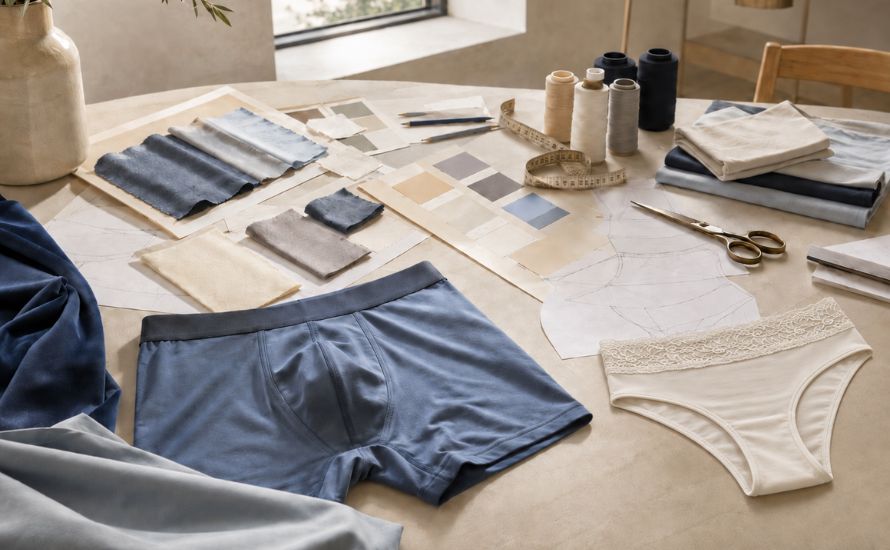
An underwear collection does not begin when a print is chosen, and it does not end when the garment leaves production. It begins earlier, with a functional question: what should each piece bring to the person who will wear it? The answer shapes the fabric, silhouette, colour, pattern and even the way each seam is constructed.
Intimate apparel has a particular design challenge: much of its quality cannot be judged from an image. It becomes clear after several hours of wear, when the waistband remains stable, the fabric moves with the body and the garment keeps its shape without demanding attention. Designing a collection therefore means connecting the creative idea with the real performance of the product.
At ZD Zero Defects, that connection is built on the selection of premium fabrics, an understanding of pattern making and production at our factory in Mataró. The creative process and manufacturing are not treated as separate worlds, but as stages of the same decision.
A coherent collection is not simply a group of similar garments: it creates a family in which every fabric, colour and pattern serves the same intention.
1. The starting point: defining what the collection is for
To understand how to design an underwear collection, it helps to begin with its purpose. A collection may respond to a season, refresh a wardrobe of essentials, introduce new silhouettes or explore a particular colour palette. In every case, function should come before decoration.
Before patterns and prototypes are developed, the following points need to be defined:
- Which types of garment will form the collection: underwear, undershirts, pyjamas, bodysuits or socks.
- The season and context in which they will be worn.
- The main sensation the collection should provide: lightness, structure, softness, freshness or warmth.
- The fit, coverage and movement requirements each style must address.
- The elements that must maintain continuity with the ZD identity.
This framework prevents the collection from depending on an isolated trend. It also makes it possible to assess every later decision: if a fabric, colour or detail does not contribute to the intended use, it probably does not belong in that proposal.
2. Designing for the body and real life
Underwear remains in continuous contact with the body and is often covered by other garments. The design must anticipate everyday positions and movements: walking, sitting, driving, sleeping or wearing several layers. A silhouette cannot be evaluated only from the front and at rest.
Each product family raises different questions:
| Garment | Priority functional decision | Intended result |
|---|---|---|
| Women’s and men’s underwear | Support, coverage, waistband and leg openings. | Stability without pressure or excess fabric. |
| Undershirts | Neckline, sleeve, length and fineness. | A discreet base layer that stays in place. |
| Pyjamas | Drape, ease and thermal sensation. | Freedom of movement and comfort during rest. |
| Bodysuits | Torso length, fastening, neckline and elasticity. | Continuous fit without pulling or unnecessary bulk. |
| Socks | Height, toe, heel and cuff. | Protection, stability and the right relationship with footwear. |
3. Fabric is not added to the design: it defines it
The same pattern changes when it is made in a more elastic, finer or more structured fabric, or in a material with a fluid drape. Fabric is therefore not chosen after the garment has been drawn: it forms part of its architecture.
At ZD, we work with Egyptian cotton, organic cotton, mercerized cotton, soy yarn and Modal. Each material guides the collection towards a different wearing experience:
- Egyptian cotton provides a balance of softness, structure and durability for garments designed for frequent wear.
- Organic cotton offers a natural feel and traceability linked to certified farming systems.
- Mercerized cotton provides fineness, stability and a subtly lustrous finish.
- Soy yarn stands out for its silky touch and gentle sensation against the skin.
- Modal makes it possible to develop lightweight, fluid garments that are particularly suited to rest.
The choice must take into account weight, knit structure, elasticity, recovery and washing. Explore the differences in our guide to choosing the best fabric for underwear.
4. The colour palette: creating an atmosphere without losing versatility
Colour shapes the emotional reading of a collection, but in underwear it must also work with the skin, the transparency of outer garments, everyday use and the continuity of the wardrobe. A well-built palette combines shades that express the concept with colours that make repeated wear easy.
The process may begin with a central shade and develop through:
- Neutrals that create continuity and make the garments easy to combine.
- Seasonal shades that update the proposal without making it short-lived.
- Controlled contrasts for trims, waistbands, prints or small details.
- Variations in depth - light, mid and dark tones - that preserve visual coherence.
- Tests on the actual fabric, because the same colour changes according to the fibre’s sheen, texture and absorption.
In pyjamas and printed collections, the relationship between the top and trousers also forms part of the design: a motif may be balanced by a plain garment, a neckline trim or a shade taken from the main print.
5. From concept to pattern: translating an idea into proportions
Pattern making translates the creative intention into specific pieces of fabric. In intimate apparel, small changes can alter the wearing experience: a few millimetres at an opening, the position of a seam, the length of a leg or the height of a waistband can all change the fit.
The pattern must organise:
- The distribution of tension to prevent concentrated pressure points.
- The amount of fabric needed to follow movement without creating folds.
- The position of seams, waistbands, bindings and fastenings.
- The adaptation of the design to the specific properties of the material.
- Grading between sizes while preserving proportion and function.
This stage turns an attractive silhouette into a viable garment. A drawing may suggest a shape; the pattern determines whether that shape works on the body.
6. Details build the identity of the collection
A collection is recognised not only by its colour or print, but by the controlled repetition of certain codes. The type of neckline, the width of a waistband, the shape of a trim or the proportions between garments can create continuity without making every piece identical.
In a ZD collection, details must meet three criteria:
- Function: the detail improves fit, comfort or durability.
- Coherence: it relates to the language of the rest of the collection and the brand.
- Precision: it can be produced and repeated with the intended standard of finish.
When an element is purely decorative, it must be integrated without adding stiffness, friction or unnecessary bulk. In underwear, appearance cannot be separated from contact with the skin.
7. The prototype: checking what a drawing cannot show
The prototype reveals how the fabric, pattern and finishes behave together. It is a testing stage, not simply a smaller version of final production. The garment is reviewed in movement and assessed against the original intention.
This stage may examine:
- The stability of waistbands, leg openings or straps.
- The position and perception of seams.
- The fabric’s drape and its recovery after stretching.
- Length and proportions across different sizes.
- The relationship between the designed colour and the result on the actual material.
If the garment does not fulfil its function, the pattern, finish or material choice is adjusted. The purpose is not to preserve the first drawing, but to preserve the experience the collection is intended to offer.
8. From an individual garment to a complete family
A collection needs variety, but also a recognisable structure. Not every style should perform the same function: some act as accessible essentials, while others provide greater coverage, introduce a print or make it possible to use the same fabric at another moment of the day.
To build the family, we review:
- Whether there is a balance between plain and printed garments.
- Whether the palette works as a whole, rather than only in each individual style.
- Whether the cuts respond to different preferences and uses.
- Whether materials are assigned to the garments in which their qualities are expressed most effectively.
- Whether any new element breaks the overall identity without a clear reason.
This functional diversity can be seen in our collections of men’s pyjamas, men’s underwear and women’s underwear.
9. Newness and continuity: how much should a collection change?
Seasonal design does not require abandoning what already works. In premium underwear, part of the value lies in permanence: recognisable patterns, reliable materials and an aesthetic that can remain relevant beyond a few months.
Newness may be introduced through colours, prints, combinations or adjustments in proportion, while the elements that support comfort remain consistent. This balance allows a collection to feel current without depending on fast-moving trends.
A coherent proposal should be able to answer yes to three questions:
- Does it add a genuinely different option to the customer’s real wardrobe?
- Does it maintain the standard of fit, feel and finish associated with the brand?
- Can it remain attractive and useful after the launch season?
10. Production in Mataró connects design with reality
Collection development does not end when the prototype is approved. The way the garments are cut, assembled and finished determines whether the result preserves the design intention. Keeping production at the Mataró factory connects creative decisions directly with their execution.
This model supports the review of patterns and finishes, process traceability and the preservation of textile knowledge. Learn more in Handcrafted production and in the article From factory to skin: how ZD underwear is made in Mataró.
The proximity between design and production does not remove the need for technique or specialised machinery. It allows technology, experience and judgement to work on the same garment with a shared objective.
11. The creative process, stage by stage
| Stage | Main question | Result |
|---|---|---|
| 1. Concept and use | What need should the collection address? | A functional brief and a clear brand direction. |
| 2. Product selection | Which families and cuts will form it? | A balanced product architecture. |
| 3. Fabric selection | What feel and performance does each garment require? | Materials aligned with the intended use. |
| 4. Palette and prints | What atmosphere and visual continuity are we seeking? | A recognisable, versatile colour system. |
| 5. Pattern making | How is the idea translated to the body? | Proportions, pieces and key fit points. |
| 6. Prototype | Does the complete garment work in movement? | Corrections to the pattern, fabric and finishes. |
| 7. Complete collection | Do the garments communicate with one another? | A varied and coherent family. |
| 8. Manufacturing and control | Does production preserve the initial intention? | Finished garments with consistent quality. |
12. What makes a collection last
A collection may be linked to a particular season and still be designed to last. Longevity does not depend only on the physical resistance of the garments, but also on whether the colours, cuts and fabrics continue to make sense in the wardrobe.
At ZD, permanence is built through:
- Raw materials selected for their feel and performance, not only for novelty.
- Patterns designed to follow the body and preserve their function.
- Restrained palettes that can accommodate seasonal accents.
- Precise finishes that prevent decorative details from compromising comfort.
- Local production that makes it possible to maintain control over the process.
This approach forms part of the brand’s history and way of producing, explored in About us and ZD Sustainability.
Conclusion: a collection is designed from the final experience
Understanding how a ZD collection is created means looking beyond the print or palette. The process begins with use, continues through fabric, pattern and prototype, and becomes tangible through manufacturing that can respect every one of those decisions.
When every stage serves the same intention, the collection stops being a list of individual references and becomes a coherent system: different garments that share feel, judgement, precision and a recognisable way of dressing the skin.
Discover the materials in Our fabrics and explore ZD collections of underwear and pyjamas.
Frequently asked questions about designing an underwear collection
What is the first step in designing an underwear collection?
Defining its function: which garments it will include, the context in which they will be worn and the sensation they should provide. Fabric, colour and pattern are then evaluated in relation to that purpose.
Is the fabric chosen before the pattern is designed?
They are connected decisions. Fabric changes elasticity, drape and recovery, so the pattern must be developed or adjusted with the actual material in mind.
How are the colours for a collection selected?
A palette is built to combine brand identity, season and use. Shades are tested on the actual fabrics because texture and sheen can change how colour is perceived.
Why is the prototype important?
It makes it possible to check fit, movement, drape and the perception of seams. It also helps correct decisions that appear suitable in a drawing but behave differently on the body.
Do all garments in a collection need to use the same fabric?
No. Different materials can be used if they all respond to the concept and the function of each garment. Coherence can be maintained through the palette, details, proportions and overall design language.
What does manufacturing the collection in Mataró contribute?
It keeps design, pattern making, cutting, sewing and finishing close together. This supports oversight, traceability and consistency between the initial idea and the finished garment.
Should a premium collection follow trends?
It may interpret them, but it does not need to depend on them. The priority is to create useful, well-resolved garments that can remain in the wardrobe beyond a single season.





