
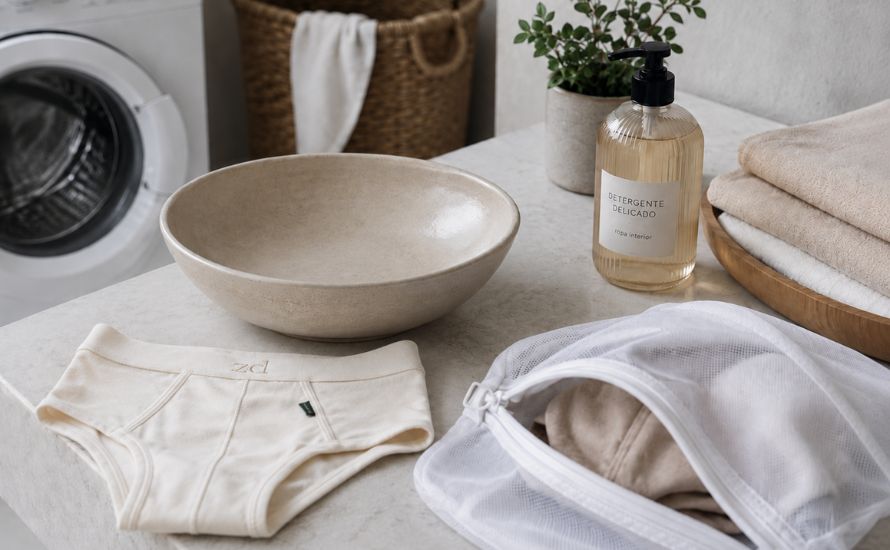
High-quality underwear is designed to move with the body for many hours and withstand frequent wear. However, its durability does not depend only on the fabric, pattern cutting or construction. The way it is washed, dried and stored can preserve its qualities or wear them out sooner than expected.
Higher temperatures, more detergent or more intensive cycles do not necessarily mean better cleaning. Underwear combines natural fibres, elastane, waistbands, fine seams and, in some cases, lace details. Effective care is usually also the most precise.
At ZD, we work with fabrics such as Egyptian cotton, organic cotton, mercerized cotton, soy yarn and Modal. You can compare them in our fabrics, but the care label sewn into each garment should always take priority when caring for a specific piece.
The fibre content provides guidance; the care label makes the decision. Care instructions apply to the finished garment, not only to its main fibre.
How to wash women’s briefs, boxers and other underwear
Although every care label sets out specific instructions, a gentle, carefully measured routine is a reliable starting point for women’s briefs, boxers, men’s briefs, undershirts and bodysuits.
1. Always begin by reading the care label
The label brings together the instructions defined for the garment’s actual combination of fabric, stretch, finish, colour and construction. Two cotton garments may require different care if one includes elastane, lace, a specific waistband or a different dye.
The symbols indicate the maximum washing temperature, the permitted cycle and whether the garment can be bleached, tumble dried, ironed or professionally cleaned. The stated temperature is a maximum, not an obligation: when a garment is not heavily soiled, a gentler permitted programme may be sufficient.
Many ZD garments recommend machine washing at a maximum of 30 °C and avoiding bleach, tumble drying, dry cleaning and ironing. However, functional products may have their own instructions. This is why each label should be checked before the first wash.
2. Sort by colour, fabric and level of soiling
Separating only whites from colours is not always enough. A balanced load reduces colour transfer and prevents delicate garments from being exposed to the friction of heavy fabrics, zips or rigid components.
- Separate whites, pale shades, bright colours and dark garments.
- Avoid washing fine underwear with denim, towels or garments with metal fastenings.
- Place lace pieces, bodysuits and particularly delicate garments in a laundry bag.
- Wash together only garments with compatible care requirements and temperatures.
- Do not overload the drum: garments need room to move and rinse properly.
If a new garment has an intense colour, wash it separately for the first few cycles and always follow the instructions on its label.
3. Turn garments inside out and protect delicate areas
Washing underwear inside out reduces direct friction on the outer surface and helps protect colours, prints and certain finishes. It also allows water and detergent to act on the area that has been in contact with the skin.
Mesh laundry bags are useful for small pieces that could become trapped between other garments, for lace underwear and for Modal or soy-yarn garments that need protection from excessive friction. Do not overfill the bag: water must be able to circulate.
4. Temperature: why 30 °C is often enough
High temperatures can accelerate the deterioration of colour, stretch fibres and certain finishes. For everyday underwear without difficult stains, a 30 °C cycle will often provide adequate cleaning when the care label allows it and the correct amount of detergent is used.
Exceptions should not be improvised. If a garment requires a specific hygiene treatment, if there is medical advice to follow or if the label indicates another temperature, that instruction should be respected. Care recommendations for period underwear should not automatically be applied to every other garment, as its construction and function are different.
5. Choose a gentle programme and moderate spin speed
The cycle matters as much as the temperature. A long, intensive programme creates more movement, twisting and friction. For underwear, a delicate or synthetics/mixed-fibre cycle is usually preferable when permitted by the care label, together with a moderate spin speed.
The aim is not to avoid spinning altogether, but to reduce unnecessary force. A waterlogged garment that is wrung out by hand can also become distorted. It is better to let the machine remove part of the water with a suitable programme and then allow the garment to dry naturally.
6. Detergent: the right amount protects better than excess
More detergent does not mean more cleaning. An excessive dose can leave residue, make rinsing more difficult and cause the garment to feel stiffer. Adjust the amount to the size of the load, the degree of soiling and the hardness of the water, following the product instructions.
- Choose a detergent suitable for delicate garments or colours when appropriate.
- Avoid products containing bleaching agents on garments whose labels prohibit bleach.
- Do not apply concentrated detergent directly to a coloured area without checking compatibility.
- Rinse thoroughly to prevent residue on garments worn against the skin for many hours.
Fabric softener is not essential either. It can leave a film on fibres and is not recommended for some functional or absorbent garments. Use it only when it is compatible with both the care label and the purpose of the garment.
7. How to wash the main fabrics used in ZD underwear
The following guidance summarises general care principles. The label of each product should take priority whenever it gives different instructions.
Egyptian cotton
Egyptian cotton combines softness and durability, but ZD garments often include stretch to improve their fit. Wash them inside out, at a low temperature and with similar colours. Avoid tumble drying when the label prohibits it, as heat can affect both the cotton and the stretch components.
Discover the characteristics of Egyptian cotton underwear and why the finished result depends as much on construction as on the fibre itself.
Organic cotton
Organic cotton is cared for in much the same way as other quality cottons: moderate temperatures, a carefully measured amount of detergent and air drying. To preserve colour and feel, avoid highly abrasive loads and bleaching products that are not permitted.
Explore the ZD selection of organic cotton garments and always check the composition and care instructions of the chosen style.
Mercerized cotton
Mercerized cotton, known in Spain as Hilo de Escocia, is a fine and durable long-staple cotton. To preserve its smooth surface and refined appearance, avoid friction with rough garments, wash at a low temperature and dry without intense heat. With socks, take particular care not to distort the cuff or toe when hanging them to dry.
Learn more about this material on our mercerized cotton page.
Soy yarn
Soy yarn has an exceptionally soft feel. ZD garments generally recommend washing at a maximum of 30 °C, without bleach, tumble drying or ironing. Use a gentle cycle, place delicate pieces in a laundry bag and allow them to air dry without wringing.
Read more about soy yarn and its use in underwear, undershirts and socks.
Modal
Modal is known for its fluid drape and silky feel. To preserve that sensation, avoid high temperatures, intense friction and wringing. A gentle programme, a drum that is not overloaded and natural drying all help maintain the shape and surface of the fabric.
Discover how we use Modal in pajamas and other lightweight garments.
8. Practical washing guide by garment type
| Garment | Preparation | Suggested wash | Drying |
|---|---|---|---|
| Boxers and men’s briefs | Inside out; wash with similar colours. | Gentle programme and the stated temperature, usually up to 30 °C. | Air dry; avoid the tumble dryer when prohibited by the label. |
| Women’s briefs and hipster briefs | Use a bag when they include lace or delicate details. | Light load, measured detergent and a gentle cycle. | Hang without stretching waistbands or lace. |
| Undershirts | Inside out and away from abrasive fabrics. | Cycle compatible with the composition and colour. | Hang or lay flat while respecting the shape. |
| Bodysuits | Close any components that may snag and use a laundry bag. | Delicate programme and moderate spin speed. | Air dry without placing pegs on delicate areas. |
| Socks | Keep pairs together without rolling them into a tight ball. | Sort by colour and fabric. | Lay out without distorting the cuff. |
| Modal pajamas | Inside out; wash in a low-friction load. | Low temperature and gentle programme. | Air dry and gently reshape. |
9. Drying: where many garments lose their shape
The heat and movement of a tumble dryer can accelerate wear on stretch fibres, shrink certain materials or alter the feel of fine fabrics. When the label states that tumble drying is not permitted, air drying is the correct option.
- Remove garments as soon as the cycle ends to prevent creasing and retained moisture.
- Gently restore the shape without stretching waistbands, straps or leg openings.
- Hang lightweight garments without placing pegs on delicate areas.
- Protect dark colours from prolonged exposure to strong sunlight.
- Do not place garments directly on radiators or other heat sources.
- Do not store underwear while it still contains moisture, even if the surface feels dry.
10. Is it better to wash underwear by hand?
Hand washing may be suitable for a very delicate garment when the care label permits it, but it is not automatically gentler. Water that is too hot, prolonged soaking, too much detergent or wringing can cause more distortion than a gentle machine cycle.
When washing by hand, dissolve a small amount of detergent first, avoid vigorous rubbing and press the garment between your hands without twisting it. Rinse until all residue has been removed and allow excess water to drain before air drying.
11. How to treat stains without damaging the fabric
Acting quickly is usually more effective than increasing the temperature or detergent later. Remove any excess without rubbing, rinse with water suitable for the type of stain and use a product compatible with the care label.
- Do not use bleach when the care symbol prohibits it.
- Test any treatment on an inconspicuous area when there is a risk of discolouration.
- Avoid stiff brushes and intense friction on fine fabrics or lace.
- Do not dry or iron the garment until you have confirmed that the stain has disappeared, as heat can set it.
12. Mistakes that shorten the life of underwear
- Always washing at the highest available temperature.
- Overloading the washing machine and increasing friction between garments.
- Using more detergent than necessary.
- Mixing delicate underwear with towels, denim or garments with zips.
- Wringing garments to speed up drying.
- Using a tumble dryer or iron when the label prohibits it.
- Storing garments before they are completely dry.
- Ignoring the fact that period underwear and other functional garments have specific care requirements.
13. A simple and effective care routine
- Read the label before the first wash.
- Sort by colour and level of delicacy.
- Turn garments inside out and use a laundry bag when necessary.
- Choose the least intensive permitted temperature and cycle.
- Measure the detergent correctly.
- Air dry while respecting the shape of each garment.
- Store only when completely dry and without excessive compression.
Conclusion: good care preserves comfort
The value of premium underwear does not end when it leaves the factory. It continues in the way the garment is worn and cared for. Precise washing helps preserve the feel, elasticity, colour and stability that keep a garment comfortable for longer.
There is no need to turn laundry care into a complicated process. Reading the label, reducing the temperature when possible, avoiding unnecessary friction and drying without intense heat are simple decisions that protect both fabrics and finishes.
Explore our men’s underwear, women’s underwear and our guide to choosing the best fabric for underwear to learn more about the characteristics of each material.
Frequently asked questions about washing underwear
At what temperature should underwear be washed?
Follow the maximum temperature stated on the care label. Many ZD garments recommend a maximum of 30 °C, although some functional products may have different instructions.
Can underwear be washed with the rest of the laundry?
Yes, provided the garments have compatible colours, temperatures and levels of delicacy. Avoid mixing them with highly abrasive fabrics or pieces with components that could snag them.
Should fabric softener be used?
It is not essential and may be unsuitable for some functional or absorbent garments. Check the label and use only a minimal amount when it is compatible.
How should lace underwear be washed?
Use a mesh laundry bag, a delicate programme, a low temperature and a moderate spin speed. Avoid mixing it with zips, hook-and-loop fasteners or heavy fabrics.
Can underwear go in the tumble dryer?
Only when the care label permits it. Many ZD garments state that tumble drying should not be used, so air drying away from direct heat is preferable.
Does underwear need to be ironed?
Usually not. Many ZD care labels state that garments should not be ironed. Reshaping the garment after washing and drying it correctly is normally sufficient.
How can underwear be prevented from losing elasticity?
Avoid high temperatures, tumble drying, excess detergent, unsuitable fabric softener and highly intensive cycles. The correct size also prevents excessive strain on stretch fibres during wear.





