
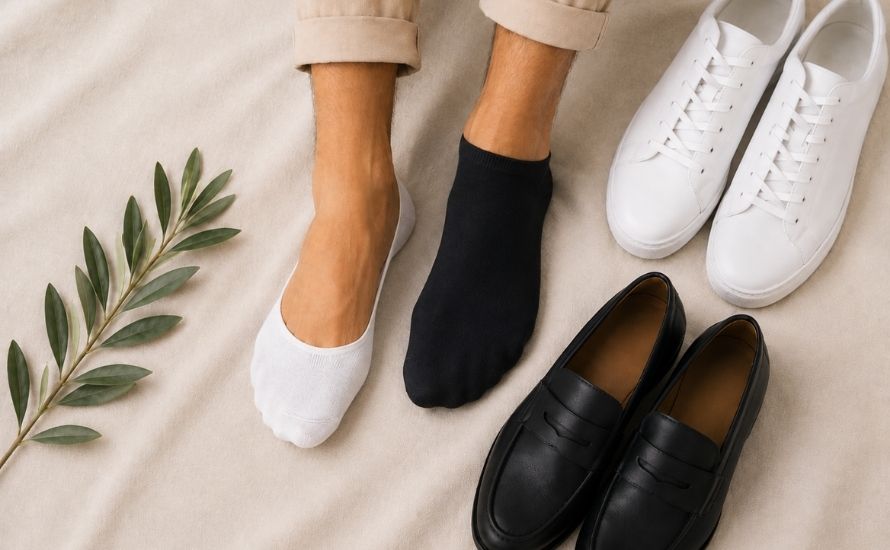
No-show socks and ankle socks look similar because both minimise leg coverage, but they do not solve exactly the same need. A no-show sock is designed to disappear inside the shoe. An ankle sock accepts being visible in exchange for providing more protection around the heel and ankle.
The difference can seem small until the footwear changes. A low-cut loafer needs a sock that stays hidden, while a trainer whose collar rubs the Achilles area may require slightly more coverage. Choosing well means looking at where the shoe ends and which part of the foot is exposed to friction during the hours it is actually worn.
In the ZD range of no-show and ankle socks there are two very different solutions: the Pinkie organic cotton sock with a silicone heel band, and the Sneaker soya sock with reinforced toe and heel areas.
|
A no-show sock prioritises invisibility. An ankle sock prioritises slightly more coverage. The best choice depends on the opening and edge of the shoe. |
1. No-show and ankle socks are not the same
|
Aspect |
No-show sock |
Ankle sock |
|
Height |
Finishes below the ankle and is designed to stay hidden. |
Reaches the ankle area and may remain visible. |
|
Main purpose |
Maintain the look of a bare ankle without giving up the protection of a sock. |
Add protection from friction without covering the lower leg. |
|
Typical footwear |
Loafers, boat shoes, low-profile trainers and wide-opening shoes. |
Sneakers, urban trainers and footwear whose collar sits close to the ankle. |
|
Critical point |
It must not slip down or show above the shoe. |
The cuff should not compress and should cover the area where the shoe rubs. |
|
ZD fabric |
Organic cotton. |
Soya yarn. |
The choice should not depend on which style seems cooler or more discreet in the abstract. It depends on the geometry of the shoe: a one-centimetre difference in the opening can make a no-show sock visible or make an ankle sock the more comfortable option.
2. When to choose no-show socks
Men's no-show socks are designed to remain hidden inside the shoe. They are especially useful when you want to keep the appearance of a bare ankle without placing the foot directly against the inside of the shoe.
· Summer loafers and low-cut shoes.
· Boat shoes and low-profile trainers.
· Shorts or rolled-up trouser hems when you want a clean visual line.
· Informal spring and summer outfits in which the sock should not become a visible part of the look.
· Footwear that holds the heel securely and does not rub above the edge of the no-show sock.
A no-show sock is not automatically the best option with every low-cut shoe. If the back edge of the shoe sits against an area of skin left uncovered by the sock, moving up to an ankle sock may be more comfortable.
3. When to choose ankle socks
ZD men's ankle-style sock reaches the ankle and creates an extra barrier against the edge of the shoe. This height often works better when a trainer covers more of the heel or when you will be walking for many hours.
· Sports and urban trainers whose collar sits close to the ankle.
· Long days standing or walking, when extra protection from friction is useful.
· Casual outfits where a small amount of sock visibility is not a problem.
· People who find no-show socks too low or prone to moving inside their usual footwear.
· Everyday wear when the soft contact of soya yarn against the skin is a priority.
4. Which sock to choose for each type of footwear
|
Footwear |
Option to consider |
What to check |
|
Very low-cut loafer |
No-show sock |
The edge stays hidden across the instep and sides. |
|
Boat shoe |
No-show sock |
It covers the heel and toes properly without showing. |
|
Low-profile trainer |
No-show or ankle sock |
Choose according to collar height and heel friction. |
|
Urban sneaker |
Ankle sock |
The shoe edge should not rub directly against the skin. |
|
Mid-collar trainer |
Ankle sock |
Check ankle coverage and stability during movement. |
|
Shoe with a rigid edge |
Ankle sock or a higher sock |
The sock should rise above the area causing friction. |
5. A no-show sock should be invisible, but also stable
The main problem with an invisible sock appears when it slips towards the sole. At that point it stops protecting the heel, creates a fold of fabric inside the shoe and has to be pulled back into place. A good no-show sock therefore needs to combine a sufficiently low pattern with an effective grip system.
The ZD Pinkie organic cotton sock includes a silicone band at the heel to help keep it in place. Its point-by-point hand-linked toe is also designed to create a flat, barely perceptible join. These details matter especially in a minimum-coverage sock, where any movement is quickly noticeable.
· The heel of the sock should align with the heel of the foot.
· The edge should not show at the sides of the shoe when an invisible effect is required.
· The grip band should hold the sock without creating uncomfortable pressure.
· The toe area should lie flat without folds beneath the toes.
6. Organic cotton: ZD’s choice for the no-show sock
The ZD no-show sock is made from organic cotton, a fibre that provides a natural feel, softness and breathability. Its composition is completed with antibacterial polyamide and elastane to improve resistance and fit.
In an invisible sock, thickness and the ability to stay in place are just as important as the fibre itself. Organic cotton helps maintain a lightweight feel inside loafers and low-profile trainers, while the rear grip band helps prevent slipping.
7. Soya yarn: softness for the ankle sock
The ZD ankle-style sock is made from soya yarn combined with cotton, antibacterial polyamide and elastane. The result is a silky, lightweight sock designed to accompany the foot during everyday wear.
Soya yarn is particularly interesting when a soft surface is a priority during prolonged contact with the skin. The style also includes reinforced toe and heel areas, two zones exposed to repeated friction inside footwear.
8. No-show and ankle socks in spring and summer
Low-cut socks are often associated with summer, but comfort does not depend on height alone. Thickness, fabric, shoe fit and accumulated moisture also matter. A very low no-show sock may be ideal with a lightweight loafer and unsuitable with a rigid trainer; an ankle sock can provide more protection without feeling excessively covered.
· With very low-cut footwear: prioritise invisibility and the fit of the no-show sock.
· With trainers: check whether the collar rubs the heel or Achilles area.
· On long days: choose a breathable fabric and a size that does not create folds.
· If the sock becomes very damp: change pairs rather than extending wear for many hours.
9. Which option protects better against friction?
The answer depends on where the friction occurs. A no-show sock protects the sole, toes and much of the heel, but leaves the upper heel and ankle exposed. An ankle sock covers more surface and may be preferable when the edge of the shoe sits precisely in that area.
If a new shoe causes friction, it is not worth insisting on the most invisible sock. The priority should be for the fabric to cover the contact point. Sometimes adding a few centimetres of cuff improves comfort more than changing the fibre.
10. How to know if the fit is correct
· The heel stays in position while walking and when removing the shoe.
· No folds form under the sole or around the toes.
· The top edge does not leave a deep mark after only a few hours.
· The sock does not twist inside the shoe.
· The size provides enough hold without relying on excessive tension.
· The toe and heel sections align with the anatomy of the foot.
If a no-show sock repeatedly slips down even when the size is correct, the pattern may simply be incompatible with the shape of that particular shoe. In that case, an ankle sock may solve the problem more effectively.
11. No-show or ankle socks according to the look
|
Situation |
Typical choice |
Visual effect |
|
Shorts + low-profile trainers |
No-show sock |
Keeps the ankle completely clear. |
|
Rolled chinos + loafers |
No-show sock |
Maintains the appearance of a bare ankle. |
|
Jeans + sneakers |
Ankle sock |
Creates a casual look and protects the shoe edge more effectively. |
|
Urban sportswear |
Ankle sock |
The sock can become a visible part of the outfit. |
|
Travel with many hours of walking |
Ankle sock |
Greater coverage against friction around the ankle. |
12. How to care for no-show and ankle socks
Both the ZD organic cotton no-show sock and the soya yarn ankle-style sock indicate machine washing at a maximum of 30 °C, with no dry cleaning, bleach or ironing.
· Wash with compatible colours and avoid temperatures above those shown on the care label.
· Do not use bleach, as it can damage fibres and colour.
· Avoid pulling the heel band of the no-show sock when removing it from the foot.
· Air dry and gently reshape the sock.
· Store pairs together without stretching the elastic around a very tight ball.
13. Common mistakes when choosing low-cut socks
· Choosing a no-show sock only because it is invisible without checking where the shoe rubs.
· Wearing a no-show sock that is too small in an attempt to hide it more effectively.
· Confusing an ankle sock with a short sock: an ankle sock finishes much closer to the ankle.
· Assuming that every no-show sock will work with every loafer or trainer.
· Ignoring the heel grip system and focusing only on the fabric.
· Choosing an ankle cuff that is too tight in an attempt to stop the sock moving.
· Keeping a damp sock on for many hours when changing pairs is possible.
14. Quick guide: no-show or ankle sock?
|
If you want... |
Choose first |
Check |
|
The sock not to be visible |
No-show sock |
Shoe opening and heel grip. |
|
More protection around the ankle |
Ankle sock |
Height of the shoe collar. |
|
Loafers or boat shoes |
No-show sock |
The edge remains completely hidden. |
|
Sneakers for many hours of walking |
Ankle sock |
It covers the friction point without compressing. |
|
A natural, lightweight feel |
Organic cotton no-show sock |
Size, heel band and thickness. |
|
A particularly silky feel |
Soya yarn ankle sock |
Fit, reinforcements and stability. |
Conclusion: the shoe determines the right height
No-show socks and ankle socks are not two names for the same garment. A no-show sock is designed to disappear; an ankle sock accepts being visible and adds a larger barrier against friction. Choosing between them means looking at the shoe opening, heel height and the amount of time you will be walking or standing.
Then comes the fabric. Organic cotton provides a soft, breathable base for the no-show sock; soya yarn gives the ankle sock a silky feel. In both cases, fit, toe construction, heel shape and stability are the details that determine whether the sock truly goes unnoticed during wear.
Explore ZD no-show and ankle socks and browse the complete men's socks collection if you also want to compare short and long styles.
Frequently asked questions about no-show and ankle socks
What is the difference between a no-show sock and an ankle sock?
A no-show sock finishes below the ankle and is designed to remain hidden inside the shoe. An ankle sock provides slightly more coverage, sits around the ankle area and may remain partly visible.
Which socks should I wear with loafers?
If the loafer has a low opening and you want the appearance of a bare ankle, a no-show sock is usually the most suitable option. Check that the edge does not show and that the heel remains protected.
Which is better for trainers: no-show or ankle socks?
It depends on the height of the shoe collar. A no-show sock can work with very low-profile trainers. If the edge rubs the heel or ankle, an ankle sock provides more protection.
How can I stop a no-show sock from slipping down?
It should fit the foot correctly and provide effective heel grip. The ZD Pinkie organic cotton sock includes a silicone heel band that helps reduce movement inside the shoe.
What fabric are ZD no-show socks made from?
The ZD Pinkie style is made mainly from organic cotton, combined with antibacterial polyamide and elastane to provide resistance and fit.
What fabric is the ZD ankle-style sock made from?
It is made from soya yarn combined with cotton, antibacterial polyamide and elastane. It has a soft, lightweight feel and reinforced toe and heel areas.
Are no-show socks only for summer?
Not necessarily, although they are especially common in spring and summer with low-cut footwear. The choice depends more on the shoe, temperature and required coverage than on a specific season.





